
Virtual Work Experience Islamic Finance with Bloomberg
This experience gave me hands-on exposure to Islamic finance through the Bloomberg Terminal and Saudi Exchange data, working through four structured tasks focused on Shariah-compliant investment analysis.
Task 1: Islamic Finance Fundamentals & Compliance
I started by building a solid foundation in Shariah-compliant investment criteria and Islamic financial instruments. This involved applying strict financial screening ratios — such as keeping total interest-bearing debt below 33% of total assets — to assess corporate eligibility. Using the Bloomberg Terminal, I verified the Shariah-compliant status of Samba Bank and explored the structural differences between Mudaraba, Murabaha, and Musharaka Sukuk.
Task 2: Market Report & Issuer Analysis
This task focused on understanding the Saudi debt market and how liquidity shapes investor behavior. I tracked the Sukuk & Bonds index at 923.92 and dug into Al Rajhi Bank's liquidity position of SAR 189,511,171.80. One of the more interesting findings was a "flight to safety" pattern — Saudi German Health's equity was declining while its Sukuk price climbed to SAR 101.96, a divergence that revealed how fixed-income instruments behave differently under market stress.
Task 3: Sovereign Sukuk Comparative Analysis
Here I compared benchmark, mid-term, and long-term government Sukuk to understand how maturity affects yield and price sensitivity. The KSA Sukuk 2041 stood out with the highest yield at 5.15%, and I calculated semi-annual return values across instruments — such as 24.25 SAR for the 2031 Sukuk — to identify which assets offered the most stable income profile for investors.
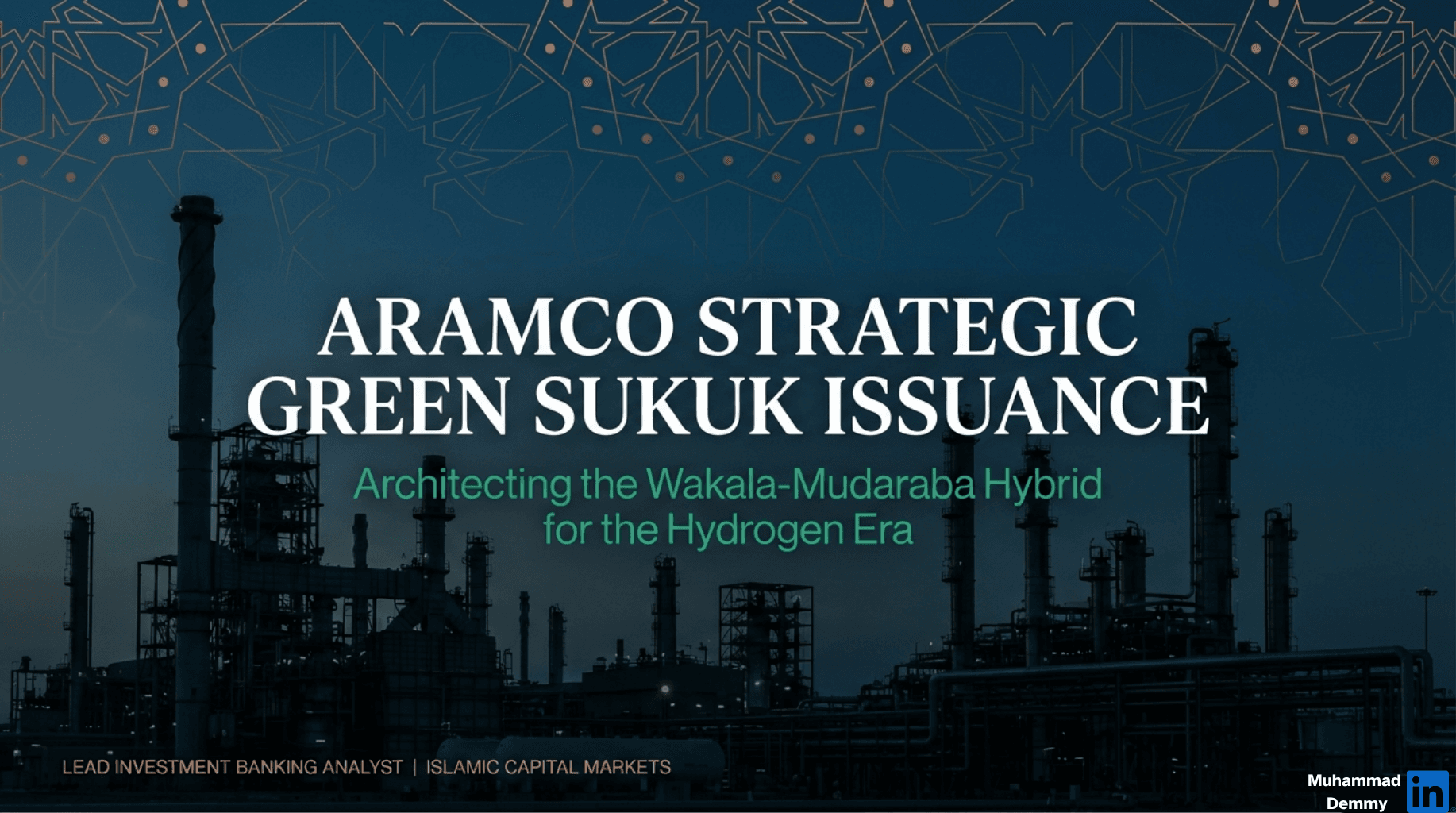
Final Task: Strategic Green Sukuk Issuance
For the final task, I designed a financing structure to support Aramco's expansion into Green Hydrogen and Carbon Capture. The proposal involved a $2 billion issuance carrying a 6.00% semi-annual coupon with a long maturity horizon set to 2070. To ensure Shariah compliance and secondary market tradeability, I structured it as a Wakala-Mudaraba Hybrid, maintaining a tangible asset ratio above 51%.